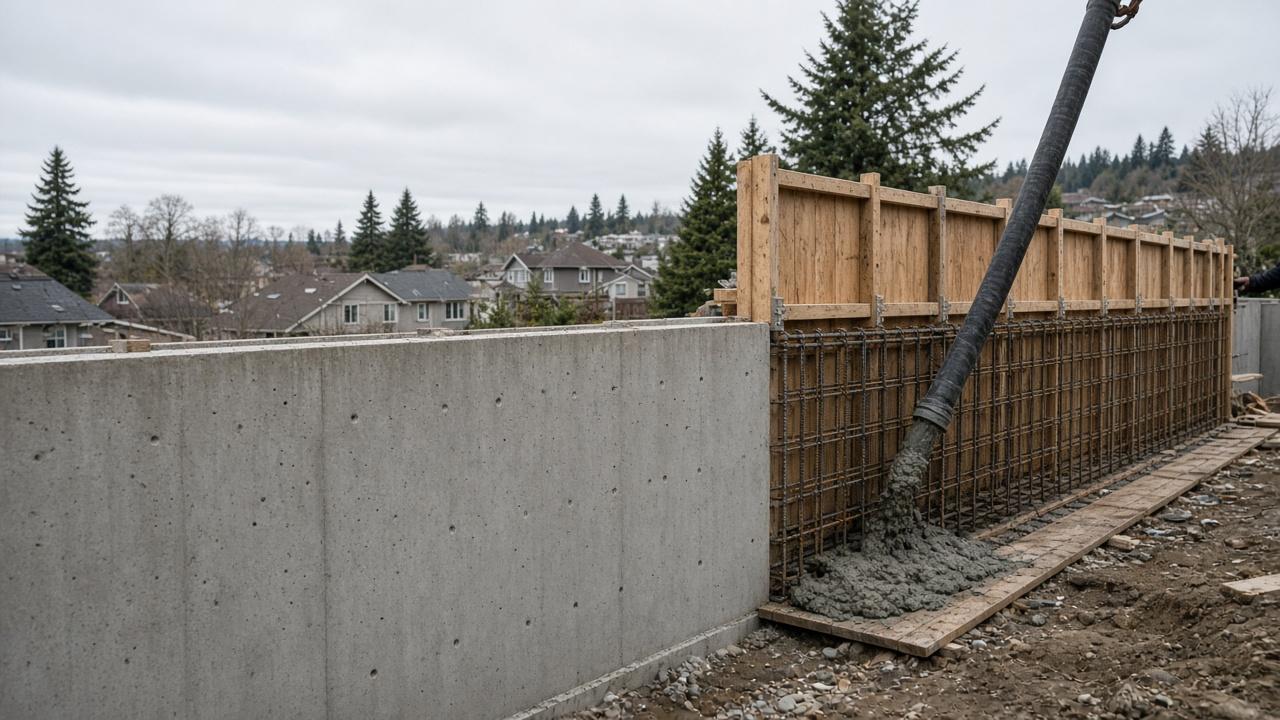
Poured Concrete Retaining Walls in Coquitlam
Monolithic poured concrete walls for maximum strength
Poured concrete retaining walls — also called cast-in-place concrete walls — are the strongest type of wall for a given height. They're the right choice for high-load situations: walls immediately behind driveways, walls supporting structures, tight urban lots where there's no room for geogrid to extend back into the soil.
When Poured Concrete Makes Sense
Segmental block with geogrid is usually the most cost-effective wall system for residential slopes in Coquitlam. But poured concrete wins in specific situations:
- **High surcharge loads**: a wall that will have a driveway, parking pad, or structure immediately behind the top of the wall needs to resist significant lateral soil pressure. Poured concrete with proper rebar sizing handles this efficiently.
- **Narrow easements or tight lots**: geogrid needs to extend back into the retained soil. If there's a fence, utility line, or neighbouring property close to the top of the wall, there may not be room for the geogrid to do its job.
- **Very tall walls**: walls over 2.5–3m are often better built in poured concrete, depending on soil and load conditions.
- **Below-grade applications**: basement retaining walls, foundation walls, and excavation support are typically poured concrete.
How Poured Concrete Walls Are Built
Excavation and footing preparation. Cast-in-place walls sit on reinforced concrete footings. The footing size and reinforcement pattern are determined by wall height and soil bearing capacity — this is engineering work, not estimation.
Rebar installation. Horizontal and vertical rebar is placed in the footing and wall according to the structural drawings. The rebar extends from the footing into the wall, creating a monolithic reinforced structure.
Formwork. Plywood and timber (or proprietary system forms) are set up on both sides of the wall to hold the wet concrete in shape while it cures. For long walls, forms are typically set in sections and 'jumped' forward as each section is poured and partially cured.
Concrete placement. We use a concrete pump truck for most wall pours — it allows precise placement without segregation, which is critical for wall integrity. Vibration is used throughout the pour to consolidate the concrete and eliminate voids.
Stripping and waterproofing. After the concrete has cured sufficiently, forms are stripped and the exposed wall face is inspected. For below-grade applications, waterproofing membrane and drainage board are applied to the soil-side face before backfilling.
Drainage and Weep Holes
Poured concrete walls are impermeable — water cannot pass through them. This means the drainage system behind the wall is even more critical than for block walls. Perforated drain pipe, drainage aggregate, and geotextile are still required. Weep holes through the base of the wall provide a secondary drainage path and pressure relief.
Common Questions About Poured Concrete Retaining Walls
Is poured concrete or block better for a driveway retaining wall?
For walls immediately adjacent to driveways with vehicular loads — especially where the driveway is at or near the top of the wall — poured concrete is typically the stronger, more reliable choice. The monolithic structure handles lateral soil pressure from vehicle surcharge more effectively.
How thick does a poured concrete retaining wall need to be?
It depends on wall height, soil conditions, and loads. A 1.2m wall might be 200mm thick. A 2.5m wall is typically 300mm or more. The structural engineer specifies both wall thickness and rebar pattern.
Get a Free Quote
Free on-site assessment. No obligation.
Why RWCC
Need a Retaining Wall
Built Right?
Every retaining wall project starts with a free on-site assessment from The Coquitlam Retaining Wall Co. We come to your property, assess the slope and soil, and give you a straight quote — no obligation.