Retaining Wall Drainage Systems in Coquitlam
Proper drainage to prevent wall failure and erosion
Water is the number one cause of retaining wall failure in British Columbia. In Coquitlam and the rest of the Lower Mainland, annual precipitation regularly exceeds 1600mm — most of it hitting between October and April. Walls that weren't built with adequate drainage don't just leak; they fail. Here's what proper retaining wall drainage looks like and why it's non-negotiable.
Why Drainage Matters More in BC Than Almost Anywhere
Soil saturation during BC's wet season creates something called hydrostatic pressure — the pressure of water-saturated soil pushing against the wall. Clay soils, which are dominant in much of Coquitlam and Port Moody's hillside areas, retain water and don't drain quickly. When water has nowhere to go, the pressure builds up behind the wall.
A wall that was sized and designed for the weight of dry soil may be significantly undersized for the same soil when it's saturated. This is why walls that look perfectly fine in September start cracking, tilting, or bowing by February.
Components of a Proper Retaining Wall Drainage System
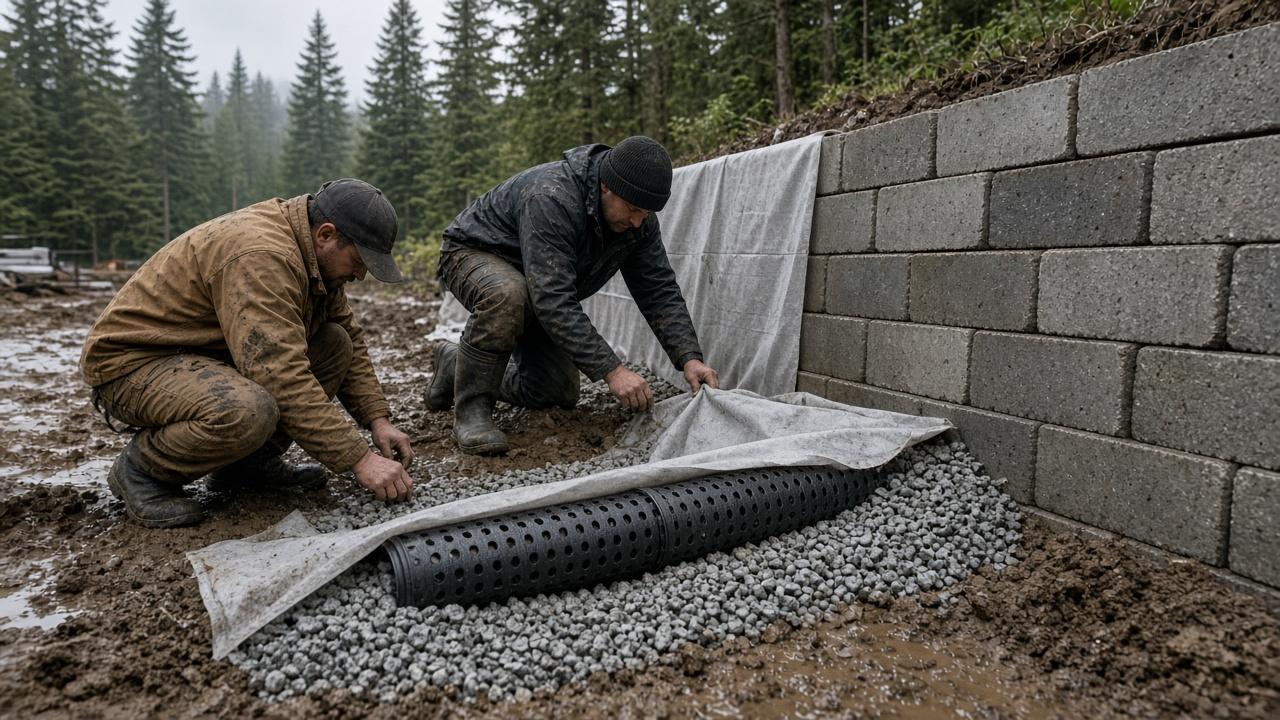
Perforated drain pipe: 100mm corrugated or PVC perforated pipe at the base of the wall, graded to drain to daylight or a suitable discharge point. This is the primary water-removal mechanism.
Drainage aggregate: washed crushed stone (20mm angular gravel, not round river rock) placed directly against the back of the wall. This creates a permeable zone that lets water move freely down to the drain pipe. The drainage layer should extend at least 300mm behind the wall face.
Geotextile filter fabric: a non-woven polypropylene fabric that separates the drainage aggregate from the native soil. Without it, fine clay particles migrate into the drainage aggregate over time, clogging it. This is what causes drainage systems that worked initially to fail after 10–15 years.
Weep holes: in poured concrete and mortared masonry walls, weep holes through the base of the wall (typically 100mm diameter holes at 1.5–2m spacing) provide a secondary drainage path and prevent complete pressure blockage if the main drain pipe fails.
Signs of Inadequate Drainage Behind an Existing Wall
- **Efflorescence (white staining)**: mineral deposits left as water evaporates through concrete or block joints. This is a reliable indicator that water is migrating through the wall under pressure.
- **Wet ground in front of the wall**: moisture seeping from base joints or weep holes (or lack thereof) indicates significant water accumulation behind the wall.
- **Progressive leaning or bulging**: often a drainage failure before it's a structural failure. The wall has been holding back increasingly heavy, waterlogged soil.
- **Popped joints or displaced blocks**: individual blocks pushed out at or near the base, where hydrostatic pressure is highest.
Repairing Drainage Without Rebuilding the Wall
If the wall structure itself is sound but drainage has failed or was never installed, it's sometimes possible to retrofit a drainage system without a full rebuild. This involves excavating behind the wall, installing drainage aggregate and pipe, and re-establishing the backfill. It's a significant excavation project but substantially less than a full wall rebuild.
Common Questions About Retaining Wall Drainage Systems
My wall is weeping water — is that normal?
If water is coming through weep holes in a poured concrete wall, that's the drainage system working as intended. If water is coming through cracks, joints, or the base of a block wall that wasn't designed with weep holes, that indicates either the drainage system is overwhelmed or hasn't been installed.
How often should retaining wall drainage be maintained?
Drain pipe outlets should be checked annually and kept free of debris. If the system was built with filter fabric and proper drainage aggregate, it should function indefinitely without maintenance. If there's no filter fabric, sediment migration into the drainage layer is a long-term concern.
Get a Free Quote
Free on-site assessment. No obligation.
Why RWCC

Need a Retaining Wall
Built Right?
Every retaining wall project starts with a free on-site assessment from The Coquitlam Retaining Wall Co. We come to your property, assess the slope and soil, and give you a straight quote — no obligation.