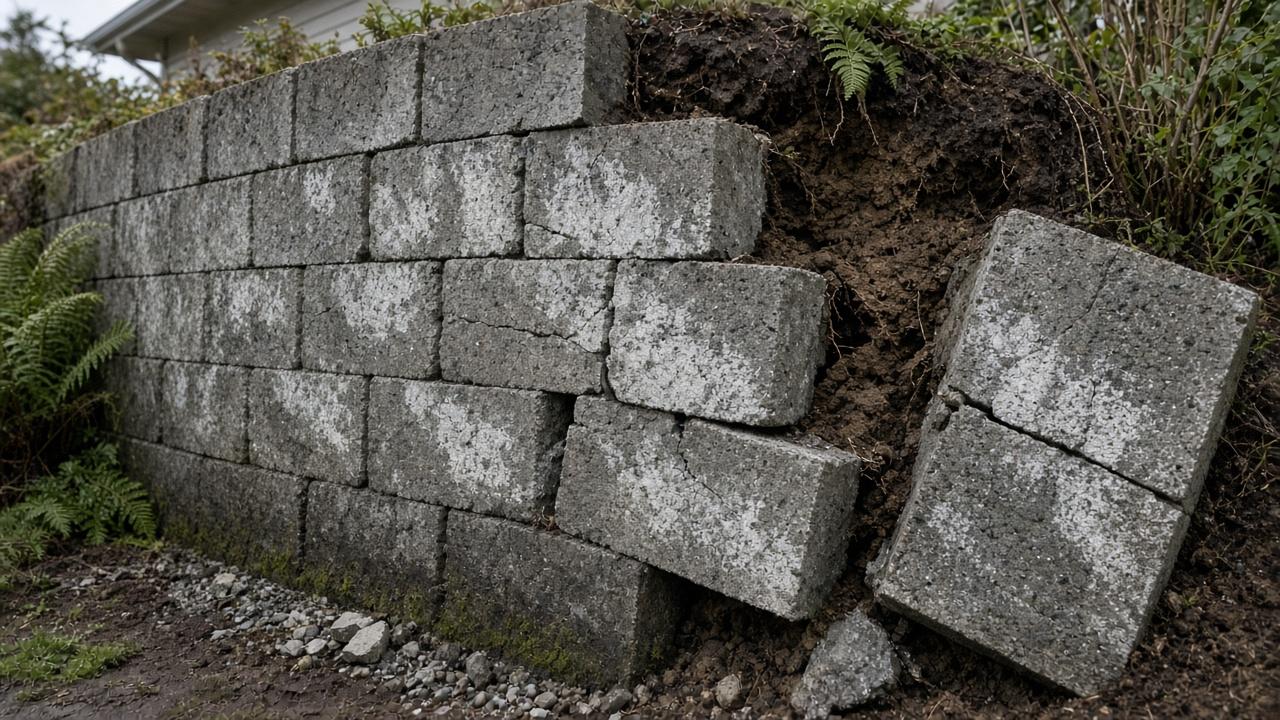
Retaining Wall Repair in Coquitlam
Fix leaning, cracking, or failing retaining walls fast
A leaning, bulging, or crumbling retaining wall isn't just an eyesore — it's a structural warning sign. In Coquitlam's wet climate, damaged walls often get worse quickly as water infiltrates behind them. The right repair approach depends entirely on what caused the problem in the first place.
Why Retaining Walls Fail in BC
Most wall failures in the Lower Mainland come down to water. Hydrostatic pressure — water pressure building up in saturated soil behind the wall — is the most common culprit. When a wall wasn't built with adequate drainage, or when existing drainage has become blocked over time, water has nowhere to go. It pushes. Eventually, the wall moves.
The second most common cause is inadequate geogrid reinforcement. Walls built without proper reinforcement or with improperly specified geogrid are chronically undersized for the load they're carrying. These walls often show up as slow leaners — they tilt a little each year until the problem becomes obvious.
Foundation failure is the third common cause. If the base course wasn't set on a properly compacted granular pad — or if the sub-grade soil was weak and wasn't addressed — the wall can sink, heave, or tilt at the base.
Diagnosing the Problem Before Starting Repairs
We don't start repairs until we understand what failed. For every repair project, we dig down at the base of the wall to inspect the footing, check for the presence and condition of drainage aggregate and pipe, probe the soil behind the wall, and assess whether the existing block system is structurally sound enough to repair or needs to be rebuilt.
This diagnostic work is what separates a repair that holds for 20 years from one that fails again in two.
Common Retaining Wall Repairs
Drainage Restoration. If the original wall is in good structural condition but drainage has failed or was never installed, we can often excavate behind the wall, install new drainage aggregate and perforated pipe, and re-establish the backfill. This resolves hydrostatic pressure without a full rebuild.
Partial Rebuild. When only a section of the wall has failed — a low spot in the base, a section where drainage was locally inadequate — targeted removal and rebuild of that section can be the most cost-effective solution.
Full Rebuild. When the base course has moved significantly, when the wall is tilted more than 1-2% from vertical, or when the original wall was simply undersized for the load, a full rebuild is usually the right answer. Trying to push a leaning wall back rarely works long-term.
When to Repair vs. When to Rebuild
If the wall has moved less than about 1" and the footing is still intact and stable, targeted repairs are often viable. If the wall has heaved, tilted significantly, or the base is compromised, a rebuild is the more reliable solution — and usually not as much more expensive as people expect, since you get a wall with a full lifespan ahead of it rather than an uncertain one.
Common Questions About Retaining Wall Repair
My retaining wall is leaning slightly — does it need to come down?
Not necessarily. A slight lean (under about 1") that has been stable for years may just need drainage attention and monitoring. A progressive lean — one that has gotten worse over time — usually indicates an ongoing structural issue that needs to be fixed properly.
Can a cracked retaining wall be repaired?
It depends on the type of crack and its cause. Hairline surface cracks in mortar joints are generally cosmetic. Through-cracks, horizontal cracks in poured concrete walls, or cracks at the base of a wall typically indicate structural movement that needs professional assessment.
How much does retaining wall repair cost?
It varies widely depending on the cause, extent of damage, and whether repair or rebuild is required. A drainage-only fix on a sound wall can be quite affordable. A full rebuild of a 30-linear-foot wall is a larger project. The only way to give you a real number is to look at the wall.
Get a Free Quote
Free on-site assessment. No obligation.
Why RWCC

Need a Retaining Wall
Built Right?
Every retaining wall project starts with a free on-site assessment from The Coquitlam Retaining Wall Co. We come to your property, assess the slope and soil, and give you a straight quote — no obligation.